Showing posts with label Hell. Show all posts

Sunday, October 22, 2006

More Hell


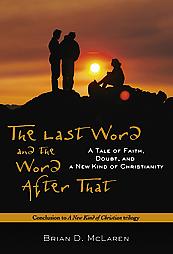
One of my posts not long ago was about some of my thoughts after doing a quick Bible review of hell. I promised to look into it a bit more- especially by reading Brian McLaren's book The Last Word and the Word After That, which deals predominantly with the subject of hell.

It's the third book in his New Kind of Christian trilogy, although the subject seems to have led to a much less pure narrative book. To me (an admitted non-expert), it provided a nice, readable outline of different views typically mentioned on the subject (inclusivism, exclusivism, conditionalism, and universalism). The characters find "problems with all those views" and sort of, but not at all very clearly, I think, suggests another take. I'll leave it to your own reading to explore these options.

I found the historical/cultural background interesting- Zoroastrian, Egyption, Babylonian, and Greek takes on the afterlife, "Hades" and similar concepts- and how that cultural environment seems to have affected the Pharisees in particular. Reviewing Jesus' statement in this context really does raise a lot of questions about the traditional Biblical support of the traditional, exclusivistic view. "So whether or not Jesus endorses the idea of hell, when the Pharisees use hell to threaten sinners to fly right, Jesus takes it and kind of turns it back on them, doesn't he?" (by saying that not showing mercy and justice to the weak/least of these is what would send you to hell).

Another useful part of the book, I thought, was the "homework assignment" that tables out all the instances in the gospels that deal with the subject of judgement (not just those that refer to hell/hades). The table has four columns: the "passage" , the "behavior", the "consequence" and "The Point". I think most people would be shocked by what the list of "behaviors" were that were being judged- for example, sexual sin isn't in the list, but "not bearing fruit" is included many times and in a variety of ways.

It is also perhaps illuminating how many different (and mutually exclusive, if taken literally) ways the consequences are expressed. Jesus is the king of metaphors and parables, after all. The "gehenna" (the perpetually burning garbage pile outside of Jerusalem translated as hell or hades I talked about in my other post) sure seems to fall right in with the rest of the metaphors, it would appear to me.

Of course, at least equally interesting and perhaps more important is "the point" of each of these cases. After all it was "the point" of the parable/statement that was, well his point- regardless of whatever other theological inferences might be made.

At the very least it has been interesting to read the thoughts of so many other well respected, thoughtful Christian scholars/authors (certainly C.S Lewis comes to mind in particular) who are highly critical/skeptical of the traditional exclusivist view.

Saturday, September 16, 2006

Quick Bible review of Hell

One of the recent Brian Mclaren books I've listened to recently seemed to hint that we've been misled a bit about the Bible's actual teaching on hell- especially what that would have meant to people of Jesus' day. My initial reaction to that was, "huh?" I know a large percentage of people these days- even Christians- supposedly don't believe in a hell, but I figured that has more to do with people not wanting to believe in hell than anything else.

I think Mclaren's The Last Word and The Word After That is supposed to have an expose' on the topic, but I decided to do a bit of Bible sleuthing on it this evening. I don't pretend to have this all sorted out, but here's what seemed to come out.

The word "Hell" is rarely used at all- indeed I think the average sitcom episode these days has the word said more than the entire Bible does. The word is always literally from the "(Valley of) Ge Hinnom"- location just outside Jerusalem that, besides having sacrifices to idols and so forth at various times done there, was in Jesus' time essentially a perpetually burning city dump. Evidently this was useful imagery.

Other phrases typically considered equivalent are things like "the fiery furnace", and "eternal fire." Interestingly, virtually all these references are used in the context of a parable, where that/those which are bad are thrown there.

"Hades" seems to be clearly distinguished as the place after death, but before the final judgement. Reportedly "hades" is equivalent to the Hebrew "Sheol" which I don't think is actually in the Bible.

Note that this dearth of specific references to "hell" is in stark contrast to "heaven" and "eternal life."

Now "punishment" gets some play- and in more explicit passages, like 2 Thes. 1:5-10:
"...will punish those who do not know God and do not obey the gospel...punished with everlasting destruction and be shut out from the presence of the Lord and from the majesty of his power." That sounds bad to me, but, as some have said, those that have fought against God may think that's actually a good thing.
Matthew 25:31ff is a pretty explicit statement too- this time by Jesus himself. He pretty clearly describes the final judgement by the "King" (not really figurative, as in parables) and the separating of the good from the bad (as "sheep from goats") with the result being "eternal punishment" versus "eternal life". It is interesting to note, by the way, that the basis for judgement here is whether love is shown to people (feeding, clothing, providing water).

All in all, it seems a bit difficult to craft a definitive statement on "Hell" from these scriptures. But several things are clear:
  1. There is clearly a Judgement
  2. There is clearly a literal "Heaven" described
  3. It is clear that not all will be in Heaven
  4. Those who won't be in heaven will be punished (evidently both after death- in "hades" and after the final Judgement)

What the punishment will be is not very clear. It seems to my rather untrained eye that a person could, yes, be punished for an eternity, as is traditionally stated. But it does seem reasonable to postulate that the punishment of "eternal destruction" and being "shut out from the presence of God and ...his power" could be consistent with the "snuffing out of existence" theories many hold. The destruction is eternal, but it is not explicitly stated, at least, that the punished are eternal. Indeed they don't have "eternal life". While the fires of the Valley of Ge Hinnom may be perpetually burning, no one thing thrown there persists very long.

Now, those are just quick thoughts after a couple of hours digging around. I'm not going to abandon all traditional theology over these thoughts, or anything, but it will be interesting to now see what can be learned from actual scholars on this subject. Someday...