Showing posts with label Brian McLaren. Show all posts

Sunday, October 22, 2006

More Hell


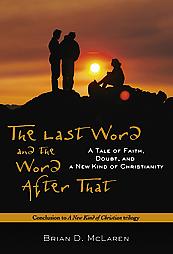
One of my posts not long ago was about some of my thoughts after doing a quick Bible review of hell. I promised to look into it a bit more- especially by reading Brian McLaren's book The Last Word and the Word After That, which deals predominantly with the subject of hell.

It's the third book in his New Kind of Christian trilogy, although the subject seems to have led to a much less pure narrative book. To me (an admitted non-expert), it provided a nice, readable outline of different views typically mentioned on the subject (inclusivism, exclusivism, conditionalism, and universalism). The characters find "problems with all those views" and sort of, but not at all very clearly, I think, suggests another take. I'll leave it to your own reading to explore these options.

I found the historical/cultural background interesting- Zoroastrian, Egyption, Babylonian, and Greek takes on the afterlife, "Hades" and similar concepts- and how that cultural environment seems to have affected the Pharisees in particular. Reviewing Jesus' statement in this context really does raise a lot of questions about the traditional Biblical support of the traditional, exclusivistic view. "So whether or not Jesus endorses the idea of hell, when the Pharisees use hell to threaten sinners to fly right, Jesus takes it and kind of turns it back on them, doesn't he?" (by saying that not showing mercy and justice to the weak/least of these is what would send you to hell).

Another useful part of the book, I thought, was the "homework assignment" that tables out all the instances in the gospels that deal with the subject of judgement (not just those that refer to hell/hades). The table has four columns: the "passage" , the "behavior", the "consequence" and "The Point". I think most people would be shocked by what the list of "behaviors" were that were being judged- for example, sexual sin isn't in the list, but "not bearing fruit" is included many times and in a variety of ways.

It is also perhaps illuminating how many different (and mutually exclusive, if taken literally) ways the consequences are expressed. Jesus is the king of metaphors and parables, after all. The "gehenna" (the perpetually burning garbage pile outside of Jerusalem translated as hell or hades I talked about in my other post) sure seems to fall right in with the rest of the metaphors, it would appear to me.

Of course, at least equally interesting and perhaps more important is "the point" of each of these cases. After all it was "the point" of the parable/statement that was, well his point- regardless of whatever other theological inferences might be made.

At the very least it has been interesting to read the thoughts of so many other well respected, thoughtful Christian scholars/authors (certainly C.S Lewis comes to mind in particular) who are highly critical/skeptical of the traditional exclusivist view.

Thursday, September 07, 2006

More on the kingdom

After now finishing out The Secret Message of Jesus, I've found much of the theme (what Jesus meant by "The Kingdom of God/Heaven is at hand" all over the place (as the book notes)- like this sermon by Tony Campolo.
Somebody gave me an article a few months ago about this very subject. Digging this article -"Is the Church Interested in the Kingdom"- back up (I kept it because it was intriguing), it turns out to be by a sociologist (Christian Smith) written in 1989. Here is some of it:

Consider the following possibility: many churches in our country today have very little to do with the kingdom of God. The kingdom of God is not a place or an institution. Nor is it the church per se. The kingdom of God is the experience of God reigning among people in history. The kingdom of God is present whenever God's will and intentions for us as individuals, communities, and societies is received and lived out.

Strange as it may sound, God is not at work in history to establish the church. God is at work to establish the kingdom, God's reign among the people of the earth. What then is the role of the church? The church is merely the human institution whose job it is to facilitate the breaking into history of the kingdom of the kingdom. It is, then a provisional institution of instrumental, not intrinsic value. The church is- or, rather can be- a channel, an instrument of the kingdom. But the church is not itself the kingdom, and its outward existence does not guarantee the presence of the kingdom.

When the kingdom of God is present, life gets changed. The kingdom changes a lot about us; our relationships, values, activities, commitments, goals, and ways of life. Because change is so central to the kingdom, Paul urged the Roman churches to "not be conformed to this world, but be transformed by renewing of your mind, that you prove what the will of God is" (Romans 12:2). The kingdom, then does- or should- produce a transformed people who, because of God's reign in their lives, live in a way that is distinctively different from the world. Unbelievers ought to be able to point to Christians and say, "Ah ha, that is what the kingdom of God looks like."

....
THE POSSIBILITY UNDER consideration is that many churches today have very little to do with the kingdom of God since they typically- rather than pursuing the kingdom like a pearl of great price- spend themselves trying to maintain and preserve their own institutions and traditions as if they were of ultimate value, are devoted to an ethic (being nice) which is fundamentally irrelevant to the concerns of God and his kingdom, and reflect a way of life virtually identical to those who have nothing to do with the kingdom of God, thereby falsifying the transformative power of the kingdom.

Ultimately, the question at issue, of course, is not a matter of good and evil, salvation or damnation, but what of our work for the Lord will stand in the end. Paul explains:

Be careful how you build upon the foundation of Jesus Christ. You can build upon the foundation with gold, silver, precious stones, wood, hay or straw. But whatever the material, the work of the builder will be clearly revealed when the day comes. That day will begin with fire and the fire will test the quality of each person's work. If anyone's work stands, they will receive a reward. But is anyone's work is burned up, they will suffer loss. Though they will be saved, it will as one who has gone through fire. (I Corinthians 3:10-15).

Thursday, August 31, 2006

Rethinking Christianity with Brian McLaren


Among all the audiobooks, audio lectures, podcasts and so forth I've become addicted to for my commutes, I've had the opportunity to listen to 3 of Brian McLaren's books. I heard him speak at a Zoe conference a couple of years ago and, while always a bit wary about just where he might go, for the most part I've found myself really appreciating most everything he's had to say. He has a way of bringing focus to what the real message of Jesus was about (particularly as in his newest book The Secret Message of Jesus). My wife and I both have enjoyed his appealling way of summarizing the Bible (in an engaging narrative form) in "The Story We Find Ourselves In", the second in his "A New Kind of Christian" trilogy.

I'm almost done with The Secret Message of Jesus. A lot of the thoughts in here I've been thinking about for awhile. Mostly things like- many, if not most, Christians have largely missed the point of Jesus' message/teachings, thinking and acting like Christianity was mostly about having the exact right beliefs and following the exact right rules. McLaren spends most of the book exploring what Jesus meant by "the Kingdom of God/Heaven". Most people today seem to read the after-life "heaven" into that phrase. McLaren believes that Jesus, in contrast, used this phrase mostly to speak of the here and now (i.e. "at hand")- God working through people's lives- individually and collectively. Here is a pretty thorough review and summary on Amazon.

I'd really like to get my family and friends to read/hear them. We've passed on "The Story We Find Ourelves In to some non-Christian, but somewhat "seeking" friends. I might even try to do a Sunday school class on The Secret Message of Jesus. Check em out.